
Watering
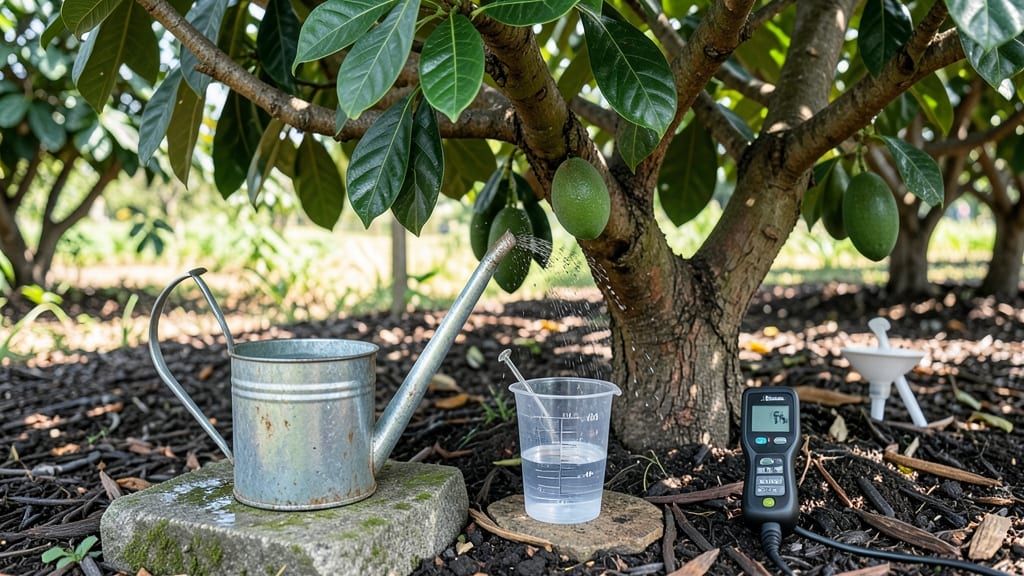
A mango tree needs deep, infrequent watering to thrive in tropical climates 🥭—about 15-20 gallons for young trees and 50+ gallons for mature ones, delivered slowly to encourage strong roots.
Here’s the catch: most gardeners either drown their trees with daily sprinkles or let them wilt under the assumption they’re drought-proof. The truth? Mango trees hate soggy soil but demand moisture deep in the root zone, especially in Zone 10-11 heat.
In this guide, I’ll break down the exact watering schedule by season—from the monsoon’s heavy rains to the dry months when your tree’s leaves start curling in protest. You’ll learn how to read the soil, spot the signs of thirst (or rot), and adjust for sandy vs. clay ground.
By the end, you’ll have a foolproof system to keep your mango tree lush, fruiting, and free from the two mistakes that kill more trees than pests ever could.
Mango tree watering requirements by season: a month-by-month breakdown
Mango trees thrive in tropical climates but require precise watering to balance their high moisture needs with their drought tolerance. Young trees demand consistent hydration, while mature specimens need strategic deep watering. The key?
Adjusting your schedule by season and tree age to avoid root rot or fruit drop. Let’s break down the ideal watering plan month by month, tailored to your mango tree’s stage of growth.
In monsoon seasons (June-September), natural rainfall often reduces your manual watering needs. However, even during heavy rains, check soil moisture at 6-8 inches deep—mango trees hate soggy roots. For dry seasons (October-May), deep watering every 7-14 days is critical, especially in USDA Zones 10-11.
During flowering (February-March), slightly reduce water to encourage fruit set, but never let the soil dry out completely.
Young mango trees (under 3 years) need 15-20 gallons per watering, while mature trees require 50+ gallons to saturate their extensive root systems. Always water at soil level, not the foliage, to prevent fungal diseases like anthracnose. Early morning (6-9 AM) is the best time to water, allowing excess moisture to evaporate before nightfall.
🌱 Pro Tip: Use a soil moisture meter to avoid guesswork. Stick it 4-6 inches deep—if it reads dry, water thoroughly. If it’s damp, wait another 3-5 days.
| Season/Month | Young Trees (Under 3 Years) | Mature Trees (3+ Years) | Key Notes |
|---|---|---|---|
| Monsoon (June-Sept) | Every 7-10 days (10-15 gallons) | Every 10-14 days (30-40 gallons) | Reduce if heavy rain; check soil moisture |
| Dry Season (Oct-May) | Every 5-7 days (15-20 gallons) | Every 10-21 days (50+ gallons) | Deep watering critical; mulch retains moisture |
| Flowering (Feb-Mar) | Every 7 days (12-15 gallons) | Every 14 days (40-50 gallons) | Slightly reduce water to boost fruit set |
| Fruiting (Apr-Sept) | Every 5-7 days (15-20 gallons) | Every 7-10 days (50-60 gallons) | Consistent moisture prevents fruit drop |
| Winter (Dec-Feb) | Every 10-14 days (10-12 gallons) | Every 3-4 weeks (30-40 gallons) | Minimal watering; avoid over-saturation |
During the monsoon season (June-September), your mango tree’s watering needs shift dramatically. While natural rainfall provides 60-80% of its needs, supplement with 5-10 gallons per watering for young trees and 20-30 gallons for mature ones if droughts occur.
Always water at the base of the tree, not the leaves, to prevent fungal spores from splashing onto foliage.
In dry seasons (October-May), mango trees rely entirely on you for hydration. Young trees should get 15-20 gallons every 5-7 days, while mature trees need 50+ gallons every 10-21 days.
Use a drip irrigation system for even distribution, especially in sandy soils, which drain quickly. Mulch with wood chips or straw to retain moisture and regulate soil temperature.
When your mango tree flowers (February-March), slightly reduce watering to encourage pollination. Overwatering during this phase can lead to excessive leaf growth at the expense of fruit.
Aim for 12-15 gallons for young trees and 40-50 gallons for mature trees every 7-14 days. This adjustment helps the tree focus energy on fruit development rather than foliage.
As fruit begins to form (April-September
Signs your mango tree is thirsty (or drowning): what to watch for
Your mango tree might be silently screaming for help—or drowning in your well-intentioned watering. The key is learning to read its leaf signals and root behavior. Unlike drought-tolerant succulents, mango trees demand balance: too little water stresses the tree, while too much suffocates its roots.
Start by checking the soil moisture 2-3 inches below the surface—this is where the real story happens.
One of the first underwatering signs is leaf wilting, especially in the hottest part of the day. Unlike temporary afternoon droop, severe wilting that lasts into the morning means your tree’s thirst isn’t being quenched.
Another red flag? Yellowing leaves that start at the edges and creep inward—a classic cry for hydration. But here’s the catch: these symptoms can also mimic nutrient deficiencies, so always check the soil first.
💧 How Much Water Does a Mango Tree Need?
| Factor | Young Trees (1-3 yrs) | Mature Trees (4+ yrs) |
|---|---|---|
| Watering Frequency | Every 7-10 days | Every 2-3 weeks |
| Volume per Watering | 15-20 gallons | 50+ gallons |
| Soil Moisture Goal | Moist but not soggy | Deeply moist (drought-tolerant) |
| Best Time to Water | Early morning (6-9 AM) | Early morning (6-9 AM) |
| Seasonal Adjustment | Increase in summer | Reduce in winter |
On the flip side, overwatering reveals itself through mushy roots and yellowing leaves with brown edges. If your tree’s leaves feel limp even after watering, or if the soil smells like rot, you’ve crossed into root rot territory.
Mango trees hate soggy feet—their roots need oxygen to thrive. A simple soil test with your finger can save your tree: if the top 3 inches stay damp for more than 48 hours, you’re overdoing it.
Pay attention to new growth too. Healthy mango trees produce bright green, glossy leaves regularly. If you notice stunted growth or leaf drop, it’s often a sign the roots aren’t getting the right balance of moisture and air.
Container-grown mangoes are especially vulnerable—their roots dry out faster, so check the soil daily during heatwaves. If the top inch is bone-dry, it’s time to water.
For corrective action, underwatered trees need a deep soak—slowly water until you see runoff at the base. Overwatered trees, however, require immediate drainage fixes: improve soil with organic matter (like compost) and avoid watering until the top 4 inches feel dry.
If root rot has set in, you may need to prune affected roots and repot with fresh, well-draining soil.
Protect your mango tree’s future by mulching around the base—this retains moisture while preventing soil compaction. And remember: consistency is key. Mango trees thrive on routine, so stick to a seasonal watering schedule and adjust based on rainfall.
Your tree will reward you with vibrant foliage and juicy fruit for years to come. 🌿