
Pruning
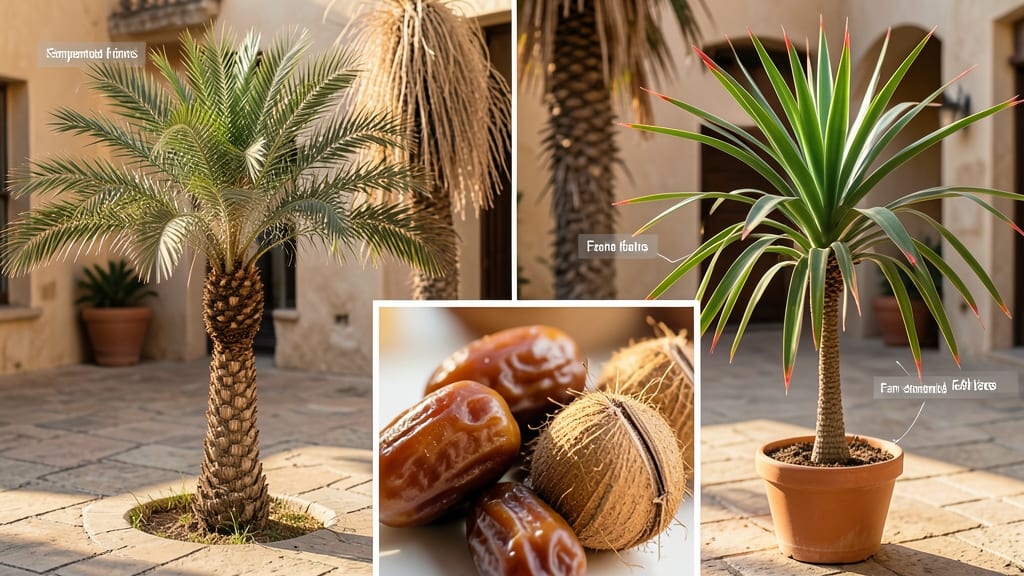
Palm trees and date trees are not the same: while date palms produce edible fruit and belong to the Phoenix genus, most common ornamental palms (like canary or Mexican fan palms) are unrelated species that yield no edible fruit. Their botanical families, leaf structures, and environmental needs differ completely.
Date palms specifically belong to the Phoenix genus within the Arecaceae family, which also includes coconut palms.
These trees produce the familiar sweet fruit we call dates, while ornamental palms like the Kentia or Bismarck palm come from entirely different genera (Howea or Bismarckia) and have no edible fruit at all.
The confusion often arises because both types share the general "palm" appearance with their tall trunks and large fronds, but their growth patterns and care requirements vary dramatically. 🌿
For example, date palms thrive in arid climates with full sun exposure, while many ornamental palms prefer partial shade and more consistent moisture.
This fundamental difference extends to their landscaping uses—date palms are cultivated for their fruit in regions like the Middle East and North Africa, whereas decorative palms are prized for their aesthetic appeal in urban and tropical settings worldwide.
💡 In This Article
- Botanical Differences Between Date Palms and Ornamental Palms
- Growing Conditions and Uses for Date Palms vs. Decorative Palms
Botanical differences between date palms and ornamental palms
Date palms belong to the Phoenix genus within the Arecaceae family, while most ornamental palms fall into entirely different genera like Trachycarpus (windmill palm), Washingtonia (Mexican fan palm), or Howea (Kentia palm).
The key difference lies in their reproductive structures: date palms produce 1-3 inch edible fruit clusters containing single-seeded stones, while ornamental palms typically bear small, non-edible seeds or no fruit at all.
This distinction is critical because it determines whether a palm can be cultivated for food or purely for decorative purposes.
The leaf morphology also reveals their differences. Date palms have pinnate leaves (feather-like fronds) that grow from the top of the trunk, while many ornamental palms like the Washingtonia genus feature palmate leaves (fan-shaped) that emerge in a circular pattern.
Even the trunk structure varies: date palms develop a thick, fibrous trunk that can reach 80-100 feet tall, whereas ornamental palms like the Chamaedorea (parlor palm) often have slender, unbranched trunks rarely exceeding 10 feet.
These structural differences influence how each palm interacts with its environment and how gardeners must care for them.
Another fascinating difference is in their flowering habits. Date palms produce yellowish-white flowers that develop into the familiar date fruit, while ornamental palms like the Caryota (fishtail palm) have branched flower clusters that resemble fish tails—hence the name.
The timing of flowering also differs: date palms typically flower in summer and fruit within 6-8 months, while many ornamental palms flower irregularly or not at all in cultivation.
This biological divergence explains why date palms are cultivated as crops while ornamental palms are valued purely for their foliage and form.
Consider the Phoenix dactylifera (date palm) versus the Washingtonia robusta (Mexican fan palm): the former produces 100-200 dates per cluster and requires full sun, while the latter produces no edible fruit and thrives in partial shade.
Even their root systems differ—the date palm develops a deep taproot system ideal for arid conditions, while ornamental palms often have shallow, fibrous roots that spread widely for stability in windy coastal areas. These botanical distinctions are why they cannot be substituted for one another in landscaping or agriculture.
For those interested in propagation, date palms are typically grown from seed or offshoots, while ornamental palms like the Chamaedorea elegans (bamboo palm) are often propagated from seedlings or tissue culture.
The growth rates also vary dramatically: date palms can take 5-10 years to bear fruit, while many ornamental palms reach maturity in 2-5 years but produce no harvestable product.
This fundamental biological separation explains why date palms are cultivated in oases and desert regions, while ornamental palms dominate urban landscapes and tropical greenhouses worldwide.
What's particularly interesting is how these differences manifest in their ecological roles.
Date palms are pollinated by wind and insects in their native Middle Eastern habitats, while ornamental palms like the Trachycarpus fortunei (windmill palm) are adapted to cooler, temperate climates where they serve as windbreaks and erosion control rather than food sources.
These ecological niches highlight why they cannot be used interchangeably—each has evolved specialized adaptations for survival in distinct environments.