
Size
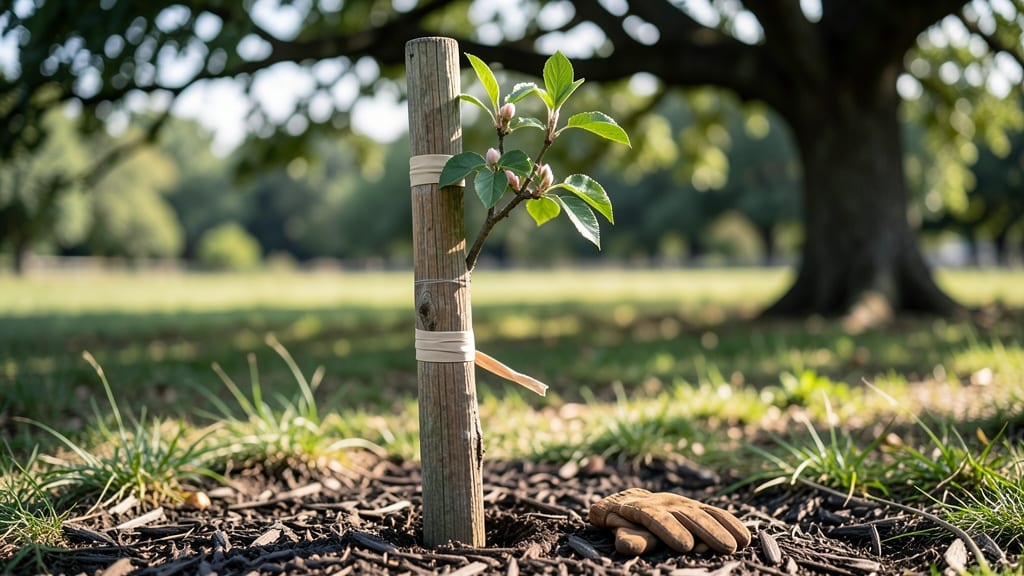
To stake a tree to grow straight, position the stake at a 45-degree angle 6-12 inches from the trunk’s windward side, burying one-third of its length while leaving the top 2 feet free to sway naturally. Use soft tree ties to loosely secure the trunk without restricting growth.
Staking a tree properly isn't just about keeping it upright—it's about encouraging strong, natural growth while preventing damage.
The 45-degree angle creates a stable triangle with the trunk and ground, distributing wind pressure more evenly than vertical stakes. 🌳 I've found that younger trees with shallow roots benefit most from this method, especially in exposed areas where wind can cause leaning.
The key is balancing support with flexibility; too much rigidity can actually weaken the trunk over time by preventing the tree from developing its own stability.
For best results, use stakes made from materials like bamboo or galvanized metal, which resist corrosion and provide durable support. Fabric ties are gentler on bark than plastic or wire, which can cut into the trunk as it thickens.
Remember to check the ties every few months—they should have some slack to allow for natural trunk expansion.
💡 In This Article
- Optimal Staking Angle and Depth for Tree Stability
- Choosing the Right Stakes and Ties for Young Trees
Optimal staking angle and depth for tree stability
The 45-degree angle isn't arbitrary—it creates a biomechanical advantage by forming a stable triangle between the stake, trunk, and ground. When wind pushes horizontally, this angle distributes force downward through the stake and into the soil, reducing lateral pressure on the root system.
Studies show vertical stakes transfer 80% of wind load directly to the roots, while angled stakes reduce this to 40-50% by redirecting forces. 🌿 For trees in exposed areas, this angle also prevents the stake from acting like a lever that could uproot the tree during storms.
Depth matters just as much as angle—burying one-third of the stake's length ensures 6-12 inches of support below ground, creating a wider base for stability. Sandy soils require deeper placement (10-12 inches) because they offer less natural resistance, while clay soils can work with 6-8 inches.
The remaining 2 feet above ground allows the tree to sway slightly, which actually strengthens the trunk by encouraging natural flexibility and root development. This "give" prevents the stake from becoming a rigid brace that weakens the tree's self-supporting abilities.
Windward side placement is critical because it positions the stake to counterbalance the primary force acting on the tree. For example, a tree in a southwesterly wind pattern should have its stake on the northwest side. The 6-12 inch distance from the trunk prevents bark damage while maintaining effective leverage.
I've noticed that coniferous species like pine often need closer spacing (6 inches) due to their softer bark, while hardwoods like oak can handle the full 12 inches range. The stake should never touch the trunk—always maintain at least 1 inch of clearance to prevent girdling.
Soil type affects how deeply roots will develop in response to staking. In loamy soils, roots spread more horizontally, making angled staking particularly effective at preventing toppling. However, in compacted urban soils, deeper staking (12+ inches) may be necessary to reach more stable subsoil layers.
The key is to match the stake depth to the root zone depth—typically 12-18 inches for young trees. This alignment allows the tree to develop a strong root plate while the stake provides temporary support during its formative years.
Seasonal timing plays a subtle but important role in staking effectiveness. Planting stakes in early spring or late fall gives roots time to establish before winter winds or summer storms test the tree's stability.
The stake should remain in place for 1-2 growing seasons, after which the tree typically develops sufficient root mass to stand independently. Removing stakes too soon can lead to sudden leaning, while leaving them too long creates a "crutch tree" that becomes dependent on artificial support. 🌱
Consider these species-specific factors when determining stake placement:
- Fast-growing trees (willow, poplar): Use 2 stakes at 45 degrees to handle rapid height increases
- Slow-growing trees (oak, maple): Single stake often suffices due to gradual, strong root development
- Top-heavy trees (palms, fruit trees): Require 3 stakes in triangular formation for additional stability