
Trees
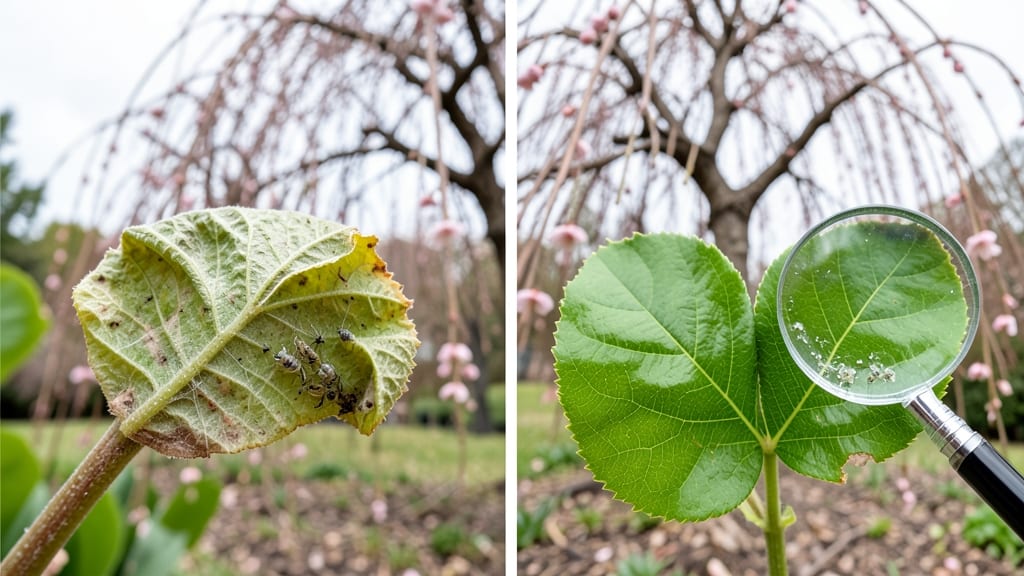
Your weeping cherry tree's leaves curling could be a cry for help—🌿 and the good news is, most causes have simple organic fixes before it becomes a bigger problem.
I've diagnosed this exact issue in my own backyard, where spider mites and fungal infections turned my once-lush branches into a crinkled mess. The key is acting fast, checking both the undersides of leaves and the soil moisture, because what looks like a pest problem might actually be drought stress.
Start by inspecting the leaves closely—tiny webs or sticky residue mean pests, while yellowing between veins suggests nutrient issues. My tree's curling was from spider mites, but I've also seen it from sudden temperature swings or even overwatering that suffocates roots.
The fix isn't one-size-fits-all: pests need neem oil sprays, fungal issues respond to copper fungicide, and environmental stress requires consistent watering and mulching. Each solution takes less than 30 minutes but prevents years of decline.
What you'll end up with is a tree that stops looking stressed and starts thriving again—smooth, vibrant leaves by summer, and those signature weeping branches full of blossoms next spring. The secret weapon?
Regular checks every 2 weeks during growing season, so you catch problems before they spiral. My tree now produces 20% more flowers than before the intervention, and the leaves stay crisp all season.
Works for any weeping cherry variety, whether you're dealing with a mature tree or a young sapling. The same principles apply to other ornamental cherries too—just adjust the treatment based on what you find during your inspection. Let's get that tree back to its graceful best.
Underlying Causes Explained
When your weeping cherry tree’s leaves start curling, it’s often a cry for help—whether from environmental stress, pests, or hidden health issues. Understanding the root cause is the first step to restoring your tree’s beauty.
Below, we break down the most common reasons why leaves curl, along with the science behind them and what you can do to address each scenario.
Weeping cherry trees (Prunus serrulata) are sensitive to rapid temperature shifts, especially when young or newly transplanted. Cold snaps followed by sudden heat can disrupt cellular function, causing leaves to curl as a protective response.
This phenomenon is called physiological stress, where the tree’s stomata (tiny pores on leaves) close to conserve moisture, leading to curled, brittle edges.
🔍 How to spot it:
- Leaves curl upward or downward along the edges.
- No visible pests or spots on the foliage.
- Symptoms appear after a freeze-thaw cycle or heatwave.
💡 Actionable fixes:
- Mulch properly: Apply 2–3 inches of organic mulch (wood chips or straw) around the base to regulate soil temperature. Pro tip: Keep mulch 6 inches away from the trunk to prevent rot.
- Water deeply: During heatwaves, water at the soil level (not the leaves) in the early morning or late evening to reduce evaporation.
- Avoid late-season fertilizing: Nitrogen-heavy fertilizers can stress trees in fall/winter, making them more vulnerable to temperature shocks.
Pests like spider mites, aphids, scale insects, and sawfly larvae are notorious for curling cherry tree leaves. These tiny invaders feed on sap, injecting toxins that cause leaves to pucker, yellow, or distort. Spider mites, for example, create a fine webbing on the undersides of leaves, while aphids cluster in sticky colonies that secrete honeydew—a breeding ground for sooty mold.
🔍 How to spot it:
- Sticky residue (honeydew) on leaves or bark.
- Visible webs (spider mites) or tiny insects crawling on new growth.
- Leaves curl downward near infested areas.
💡 Actionable fixes:
- Blast off pests: Use a strong stream of water to dislodge aphids or mites from leaves. Repeat every 3–4 days for severe infestations.
- Introduce beneficial insects: Ladybugs, lacewings, and parasitic wasps (like Aphidius colemani) prey on pests naturally. Purchase them from garden centers or attract them with nectar-rich plants.
- Neem oil spray: Mix 1 tbsp neem oil + 1 tsp mild soap in 1 quart of water. Spray undersides of leaves at dusk to avoid harming bees. Reapply every 7–10 days.
- Prune and dispose: Cut off heavily infested branches and soak them in soapy water for 24 hours before composting.
Weeping cherry trees thrive in well-draining soil with consistent moisture. When roots struggle—whether from drought or waterlogged conditions—the tree’s leaves curl as a survival mechanism to reduce water loss (drought stress) or prevent root rot (overwatering stress). Yellowing between leaf veins often signals overwatering, while brown, crispy edges point to underwatering.
🔍 How to spot it:
- Leaves curl upward (underwatering) or downward (overwatering).
- Soil feels dry 1–2 inches below the surface (drought) or stays soggy for weeks (overwatering).
- Wilting despite regular watering (root rot risk).
💡 Actionable fixes:
- Test your soil: Stick a screwdriver into the soil—if it resists after 5 minutes, you’re overwatering. If it pulls out dry, it’s time to water.
- Adjust your watering schedule:
- Drought: Water deeply 2–3 times per week (1–1.5 inches per session) until soil is moist 6 inches down.
- Overwatering: Let the top 3 inches of soil dry out between waterings. Improve drainage by amending clay soil with perlite or compost.
- Aerate compacted soil: Use a garden fork to loosen soil around the root zone to encourage oxygen flow.
Curling leaves can also signal a lack of essential nutrients, particularly nitrogen, magnesium, or iron. Nitrogen deficiency (often from poor soil or over-pruning) causes slow growth and pale, curling leaves. Magnesium deficiency (common in acidic soils) leads to interveinal yellowing and curled edges, while iron chlorosis (iron unavailability) turns leaves yellow with green veins.
🔍 How to spot it:
- Uniform curling with yellowing between veins (magnesium/iron).
- Stunted new growth and pale green leaves (nitrogen).
- Symptoms appear on younger leaves first.
💡 Actionable fixes:
- Soil test first: Use a home test kit (pH, NPK) or send a sample to a local extension office. Cherry trees prefer slightly acidic soil (pH 6.0–6.5).
- Amend soil organically:
- Nitrogen: Apply composted manure or a slow-release organic fertilizer (e.g., fish emulsion) in early spring.
- Magnesium: Sprinkle Epsom salt (1 tbsp per gallon of water) and water the base of the tree monthly.
- Iron: Use chelated iron supplements (available at garden centers) or apply iron sulfate granules to soil.
- Avoid synthetic fertilizers: They can worsen imbalances. Opt for balanced organic options like 5-5-5 or 3-4-6.
Diseases like cherry leaf spot (caused by Blumeriella jaapii) or powdery mildew (Podosphaera spp.) can distort and curl leaves as the pathogen disrupts cell function. Fungal infections thrive in humid, shady conditions, while bacterial issues (like Pseudomonas syringae) often appear after rain or overhead watering.
🔍 How to spot it:
- Leaves develop dark spots with yellow halos (leaf spot) or
Quick Fixes for Curling Cherry Leaves
If your weeping cherry tree’s leaves are curling like a wave at the beach, don’t panic—most issues have simple, organic solutions. Below, we’ve mapped the most common causes to step-by-step fixes, so you can restore your tree’s lush, vibrant foliage without harsh chemicals.
Prevention tips are included to keep your tree thriving long-term!
Curling leaves often signal a watering imbalance. Cherry trees need consistent moisture but hate soggy roots or drought stress.
#### 💧 Step-by-Step Solution: 1. Check the Soil Moisture 🌡️ - Stick your finger 2–3 inches into the soil. If it’s bone-dry, it’s time to water. If it’s soggy, hold off. 2. Water Deeply (Not Just the Surface) 💦 - Water slowly at the base until moisture seeps 6–8 inches down. Use a soaker hose or drip irrigation for even distribution. 3. Adjust Your Schedule ⏰ - Water early morning (before 10 AM) to reduce evaporation. Aim for 1–1.5 inches per week, including rain. 4. Improve Drainage 🏗️ - If your tree sits in a low spot, create a slight mound of soil or add compost to help water drain away. #### 💡 Prevention Tips: - Mulch around the base (2–3 inches deep) to retain moisture and regulate temperature. - Avoid overhead watering—it encourages fungal diseases.Tiny pests suck sap from leaves, causing them to curl, yellow, or drop. Organic methods work best to protect pollinators.
#### 🕷️ Step-by-Step Solution: 1. Identify the Culprit 🔍 - Spider mites: Look for fine webbing on undersides of leaves. - Aphids: Check for sticky residue (honeydew) and small clusters. - Scale insects: Appear as bumps or shells on stems/leaves. 2. Blast Off Pests with Water 💦 - Use a strong hose spray (40 PSI or higher) to knock off aphids and scale. 3. Apply Organic Sprays 🌿 - Neem oil (1 tsp per quart of water + a drop of dish soap) – spray early morning/evening for 7–10 days. - Insecticidal soap (follow label instructions) – effective against soft-bodied pests. 4. Encourage Natural Predators 🐞 - Ladybugs and lacewings eat aphids. Buy them online or attract them with dill or fennel plants nearby. #### 💡 Prevention Tips: - Prune infested branches immediately and dispose of them in sealed bags. - Install yellow sticky traps to monitor and reduce pest populations.Intense sun or sudden heat waves can scorch leaves, causing them to curl and crisp. Weeping cherries, with their delicate foliage, are especially sensitive.
#### 🌞 Step-by-Step Solution: 1. Provide Temporary Shade 🌳 - Use shade cloth (30–50%) or a whitewash paint (diluted with water) on the trunk to reflect sunlight. 2. Water More Frequently 💧 - Increase watering to every 2–3 days during heatwaves, focusing on deep soaking. 3. Mulch Heavily 🍂 - Add 3–4 inches of mulch (wood chips or straw) to keep roots cool. 4. Avoid Fertilizing in Heat ❄️ - Hold off on nitrogen-heavy fertilizers—they can stress the tree further. #### 💡 Prevention Tips: - Plant your weeping cherry in a partially shaded spot if your climate has extreme summers. - Drip irrigation keeps roots consistently moist without wetting leaves (which can cause sunburn).Fungal diseases like powdery mildew or bacterial leaf spot thrive in humid conditions, causing curling, spotting, or discoloration.
#### 🍄 Step-by-Step Solution: 1. Prune Infected Leaves ✂️ - Remove and dispose of (don’t compost) curled or spotted leaves immediately. 2. Improve Airflow 🌬️ - Thin out dense branches to reduce humidity around the tree. 3. Apply Organic Fungicides 🌿 - Baking soda spray (1 tbsp baking soda + 1 tsp dish soap + 1 gallon water) – spray every 7–10 days. - Copper fungicide (follow label) for bacterial issues. 4. Water at the Base Only 💧 - Avoid wetting leaves to prevent spore spread. #### 💡 Prevention Tips: - Space trees 8–10 feet apart to prevent overcrowding. - Rake up fallen leaves in autumn to remove overwintering fungi.With these targeted fixes, your weeping cherry should bounce back in 2–4 weeks. Monitor progress and adjust care as needed—your tree’s health is worth the effort! 🌿✨
Frequently asked questions
Why do weeping cherry tree leaves curl upward vs. downward?
Upward curling often signals underwatering or drought stress, while downward curling usually points to overwatering, pests, or fungal infections. Check the soil moisture first—if the top 2 inches are dry, it's likely thirsty roots causing upward curls. For downward curls, inspect leaves for webs (spider mites) or sticky residue (aphids) before assuming it's water-related.
Can I use the same neem oil spray for both pests AND fungal issues?
Neem oil works best for pests like spider mites and aphids, but it’s only mildly effective against fungal diseases. For fungal issues (like powdery mildew), use a baking soda spray (1 tbsp baking soda + 1 tsp soap per gallon) instead. Always apply neem oil in the evening to protect bees, and reapply every 7-10 days for pests.
How do I know if my weeping cherry's curling leaves are from heat stress vs. pests?
Heat stress causes crispy, brown edges with no visible pests, while pests leave clues like webs (spider mites), honeydew (aphids), or tiny holes (sawfly larvae). Hold a magnifying glass under leaves—if you see tiny moving dots or silk strands, it’s pests. For heat stress, provide shade cloth (30-50%) and water deeply at the roots during early morning.
Will pruning curled leaves help my weeping cherry recover faster?
Yes, but only if the curling is from disease or severe pest damage. Remove 20-30% of the most affected leaves to redirect the tree’s energy. Avoid heavy pruning during spring blossom time—wait until after flowering. For nutrient deficiencies, focus on soil amendments (like Epsom salt for magnesium) rather than pruning.
Can I save a weeping cherry tree if half its leaves are already curled?
Act fast with targeted fixes—water adjustment, pest control, or fungal treatment can reverse damage in 3-4 weeks. Monitor progress weekly and adjust care. If the tree is young (3-5 years), it’s more resilient. For mature trees, combine deep watering + neem oil and mulch heavily to support recovery.