
Companion Plants
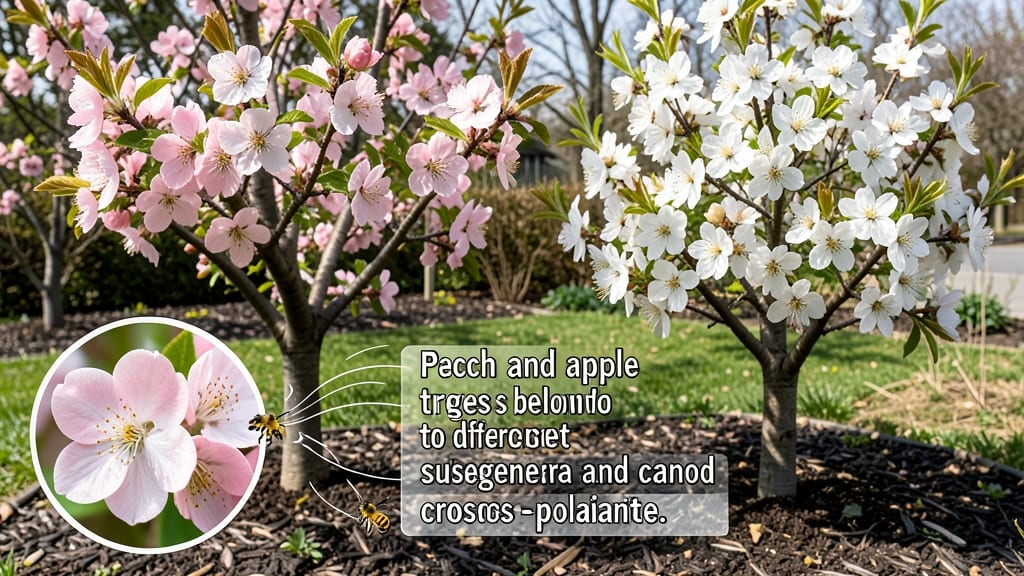
Peach trees cannot pollinate apple trees because they belong to different botanical families—Prunus for peaches and Malus for apples—meaning their flowers are structurally incompatible and share no overlapping pollinators.
Peach and apple trees are like two different languages when it comes to pollination. 🌸 The Prunus family (peaches) and Malus family (apples) have evolved separately for millions of years, leading to key differences in flower structure and pollinator preferences.
For example, peach flowers often rely on bees, while many apple varieties depend on wind or different bee species—meaning even if pollen somehow transferred, it wouldn't result in successful fertilization. This biological mismatch explains why gardeners can't simply plant them together expecting fruit.
What's fascinating is how this affects fruit production. Apple trees often need another apple variety nearby for cross-pollination, while peach trees typically self-pollinate or need compatible peach varieties. This family-level incompatibility means you'd need to plant entirely separate orchards for each fruit type if you want reliable harvests.
The lesson here? Always check botanical families before planning mixed fruit tree gardens!
💡 In This Article
- Botanical Differences Between Peach and Apple Trees
- Best Pollination Partners for Peach and Apple Trees
Botanical differences between peach and apple trees
The fundamental barrier to cross-pollination lies in their flower anatomy and reproductive biology. Peach flowers (Prunus persica) feature stamens positioned to release pollen that's optimized for bee transfer—thick, sticky grains designed to cling to fuzzy bee legs.
Apple flowers (Malus domestica), however, produce lighter, powdery pollen that disperses easily in wind currents, their stigmas adapted to catch airborne grains. This structural mismatch means even if pollen somehow transferred, it wouldn't align with the recipient flower's fertilization mechanisms.
Genetic divergence plays an even bigger role. Peach and apple chromosomes differ significantly—peaches have 8 pairs (2n=16) while apples have 17 pairs (2n=34)—making hybrid embryos impossible.
The biochemical signals between their pollen and stigma also don't match: apple pollen contains malusin, a protein that triggers apple stigma receptivity, while peach pollen lacks this compatibility factor. 🌿 Even if bees carried peach pollen to an apple flower, the pollen tubes wouldn't grow through the apple's style to reach the ovary.
Pollinator preferences further complicate things. Most peach varieties rely on honeybees (Apis mellifera) or native solitary bees, whose foraging behavior favors heavy, sticky pollen.
Apple trees often depend on wind pollination (especially crabapple varieties) or different bee species like bumblebees, which have longer tongues to access apple blossoms' deeper nectaries. This pollinator specialization creates an ecological divide that nature hasn't bridged over millions of years.
Temperature also affects compatibility. Peach flowers bloom optimally at 60-75°F, while apple blossoms prefer 50-65°F—meaning their peak bloom periods rarely overlap in most climates.
Even in ideal conditions, the 14-day pollen viability window for peaches doesn't sync with apple trees' 7-10 day receptive period, creating a temporal mismatch that prevents natural cross-pollination.
What's most surprising is how these differences manifest in fruit development. If you tried to force cross-pollination, you'd see apple flowers wilt without setting fruit, while peach flowers might show temporary swelling before aborting—both responses are the plant's way of rejecting incompatible pollen.
This biological safeguard explains why nature maintains such clear species boundaries between these fruit trees.
The takeaway? These differences aren't just theoretical—they're visible in every aspect of the trees' reproductive biology, from flower structure to pollinator relationships to genetic compatibility. Understanding these mechanisms helps gardeners make informed choices about which fruit trees to plant together for successful pollination and fruit production.