
Blooming
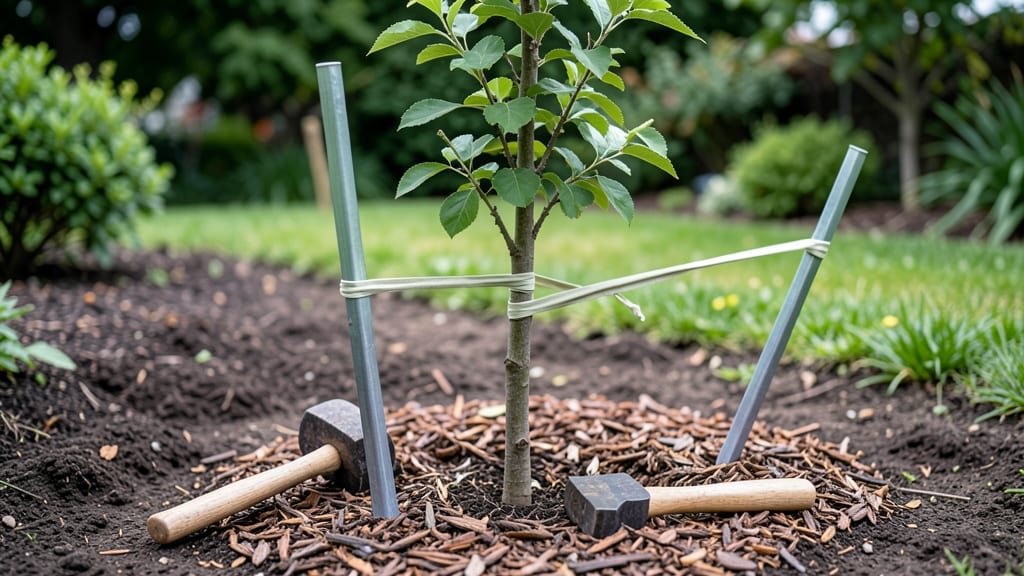
To determine how long a tree should be staked, plan for 6 months to 2 years based on species, soil conditions, and growth rate. Trees typically need support until their roots establish firmly and trunks thicken enough to stand upright without assistance, especially in windy or heavy-soil areas.
Understanding how long to stake a tree depends on its natural growth patterns and environmental challenges. 🌳 Young trees with shallow root systems—common in sandy or rocky soils—often require stakes for the full 2-year window, while faster-growing species in fertile loam may only need 6-12 months.
I’ve seen willow trees, for example, stabilize in as little as 3 months, whereas oak saplings can take closer to 2 years. The key is monitoring trunk diameter: when it reaches about 1 inch at ground level, the tree usually has enough structural integrity to stand alone.
Seasonal timing also plays a role—staking during the growing season (spring to early fall) gives roots more time to adapt, while winter staking can stress the tree. Always check for stability by gently pushing the trunk; if it doesn’t wobble, it’s ready for stake removal.
Removing stakes too soon risks bending or breaking the trunk, while leaving them too long can cause the tree to become dependent on artificial support.
💡 In This Article
- Factors Determining Tree Staking Duration
- Step-by-Step Guide to Safely Removing Tree Stakes
Factors determining tree staking duration
The primary factor in staking duration is root development, which varies dramatically by species. Fast-growing trees like willows or poplars can establish roots deep enough to stabilize within 3-6 months, while slow growers like oaks or maples may need 2 years or more.
The rule of thumb is that a tree’s root system typically extends 12-18 inches outward for every 1 inch of trunk diameter above ground. 🌱 For example, a 1-inch caliper tree needs roots reaching 12-18 inches deep to support itself.
Soil type dramatically impacts how quickly roots anchor. Clay soils, which compact easily, can delay root penetration by 30-50% compared to loose, well-draining loam. Sandy soils, while easier for roots to penetrate, offer less mechanical support, requiring staking for longer periods.
Wind exposure is another critical variable—trees in open areas need stakes until their trunks reach 1.5-2 inches in diameter, while sheltered trees may stabilize sooner. Seasonal planting also matters: trees planted in spring or early fall have more time to establish before winter stress sets in.
The trunk’s ability to resist bending is directly tied to its diameter and wood density. A 1-inch diameter trunk can typically handle 5-10 pounds of lateral force before bending, while a 2-inch trunk can withstand 20-40 pounds.
This is why species like birch (softwood) often need longer staking than hickory (hardwood). 🌳 The key is to monitor trunk growth—when it reaches 1 inch at ground level, most trees have developed sufficient structural integrity to stand without support.
Environmental stress factors like drought or construction activity can extend staking needs by 20-40%. Trees planted near buildings or sidewalks may also need additional support due to underground obstructions that limit root spread.
Always check for stability by gently pushing the trunk—if it resists movement, the tree is likely ready for stake removal. However, never remove stakes during high winds or after heavy rains, as these conditions can reveal hidden instability.
Species-specific growth rates play a surprising role. For instance, fruit trees like apple or cherry often need 12-18 months of staking because their top-heavy canopies create additional leverage. Meanwhile, conifers like pine or spruce may require staking for 2-3 years due to their flexible, needle-laden branches that catch wind.
The general guideline is to stake until the tree’s trunk diameter equals its height in feet divided by 20—this simple ratio helps predict when natural stability will be achieved.
One often-overlooked factor is the quality of the stake itself. Poorly installed stakes (too tight, improper angle) can actually delay natural trunk strengthening by creating dependency.
The ideal stake system should allow 5-10 degrees of trunk movement to encourage wood thickening. 🌿 Always use 3 stakes for large trees and 2 stakes for small ones, positioned at 120-degree intervals to distribute stress evenly.