
Pruning
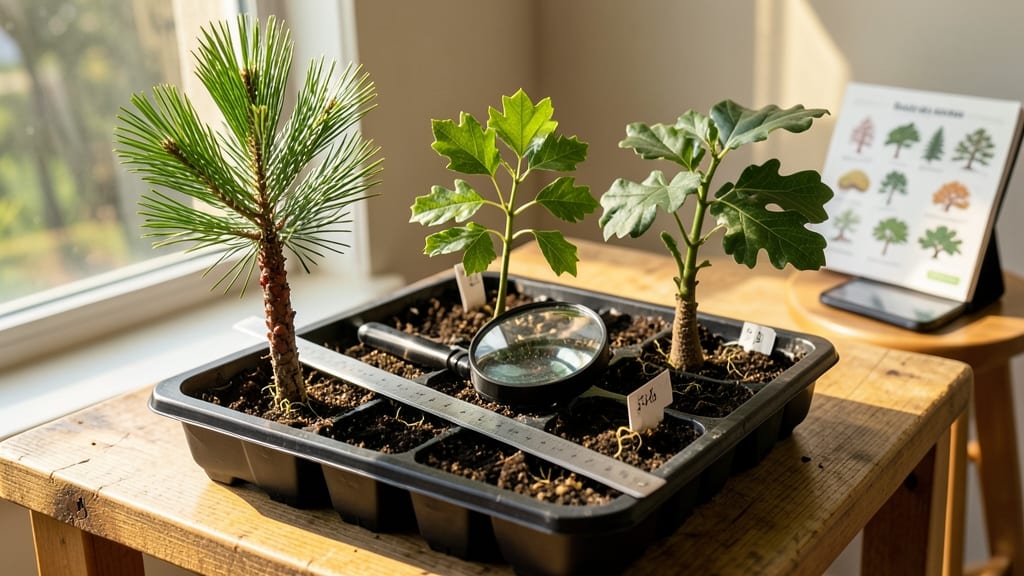
The identification of tree seedlings by their leaves and bark saves you from years of guesswork. 🌱 I’ve spent countless hours staring at tiny sprouts, only to realize I’d planted the wrong species—until I learned to read the clues nature gives us right from the start.
The secret lies in three details: leaf shape (needle-like, lobed, or smooth-edged?), bark texture (smooth, furrowed, or scaly?), and growth pattern (single trunk or clustered stems?). A magnifying glass and a field guide become your best tools—no green thumb required.
You’ll spot oak seedlings by their bristly lobes or pine saplings by their soft needles, making planting decisions effortless. Mistakes here mean years of pruning or even removing the wrong tree. This works for backyard plots, urban lots, or restoration projects. Let’s turn those mystery sprouts into confident matches!
Why Seedlings Look So Confusing
Identifying tree seedlings can feel like solving a botanical puzzle—especially when similar species share overlapping traits like leaf shape or bark texture. But why do these young trees throw us for such a loop?
The answer lies in a mix of natural growth patterns, environmental pressures, and even human interference. Let’s break down the science behind the confusion.
Seedlings often lack the defining features of their mature counterparts. For example, a white oak (Quercus alba) seedling might have lobed leaves similar to a red oak (Quercus rubra), but its bark and overall growth habit won’t match until it’s decades old. This is because:
- Leaf morphology shifts: Young leaves prioritize maximizing sunlight absorption over species-specific shapes, leading to broad, simple leaves that later develop lobes or serrations.
- Bark develops slowly: Smooth, thin bark in seedlings can resemble dozens of species, while mature bark—like the deep ridges of a sycamore (Platanus occidentalis)—takes years to form.
- Growth form varies: A maple (Acer) seedling might grow upright like a pine, while its adult form branches horizontally. This makes height and shape unreliable early identifiers.
Actionable tip: 🔍 Focus on secondary traits like leaf arrangement (alternate vs. opposite), vein patterns, or the presence of stipules (small leaf-like structures at the base of the leaf stem). These often stay consistent from seedling to sapling.
Drought, poor soil, or shade can warp a seedling’s appearance, making it resemble a different species entirely. For instance:
- Nutrient deficiency: A birch (Betula) seedling starved of magnesium may develop yellowing leaves with jagged edges, mimicking a beech (Fagus) or hickory (Carya).
- Competition for light: Seedlings growing in dense shade often produce larger, thinner leaves to capture more sunlight—a trait that can blur lines with unrelated shade-tolerant species like dogwood (Cornus) or serviceberry (Amelanchier).
- Fungal or pest damage: Gall-forming insects or pathogens can distort leaf shapes, making a healthy oak seedling look like a walnut (Juglans) or vice versa.
Actionable tip: 🌡️ Compare seedlings from the same healthy environment. If one stands out with odd traits, check for pests (like aphids or mites) or soil tests for deficiencies.
When two closely related species grow near each other, their seedlings can hybridize, creating a genetic mishmash that defies easy identification. Common hybrid pairs include:
- Oak hybrids: A cross between white oak and bur oak (Quercus macrocarpa) might have leaves with intermediate lobing and bark that doesn’t match either parent.
- Willow hybrids: Black willow (Salix nigra) and crack willow (Salix fragilis) hybrids can have leaves that are neither narrow nor lance-shaped but somewhere in between.
- Poplar hybrids: Eastern cottonwood (Populus deltoides) and balsam poplar (Populus balsamifera) hybrids may have triangular leaves with a mix of fuzzy and smooth undersides.
Actionable tip: 🌿 Look for sterile flowers or uneven fruit—hybrids often produce fewer or non-viable seeds. Also, note the parent trees’ proximity; hybrids thrive where species overlap.
Many seedlings are sold or planted under incorrect names due to:
- Nursery errors: Misidentified stock or lazy labeling can mean a "sugar maple" seedling is actually a boxelder (Acer negundo), which has compound leaves instead of simple ones.
- Grafting confusion: Grafted trees (like fruit trees) may have roots from one species and a top growth from another, leading to hybrid-like traits.
- Regional name chaos: A tree called a "sourwood (Oxydendrum arboreum)" in the South might be labeled "sorbus" in another state, causing identification headaches.
Actionable tip: 📋 When in doubt, cross-reference with local botanical databases (like USDA Plants) or consult a mycorrhizal expert—they often know the quirks of regional mislabeling.
Practical steps to master seedling ID
Accurately identifying tree seedlings can feel like solving a botanical puzzle—especially when leaf shapes and bark textures blend together. But with the right approach, you can turn confusion into confidence.
Below, we break down common challenges in seedling identification and provide step-by-step solutions, plus prevention tips to keep your green thumb sharp.
If two seedlings seem nearly identical at first glance, don’t panic. The key is to compare multiple features, not just one. Here’s how:
🌿 Step 1: Examine Leaf Arrangement and Venation
- Cause: Over-reliance on leaf shape alone can lead to misidentification.
- Fix:
- Alternate vs. Opposite Leaves: Hold the seedling at eye level. Are the leaves staggered (alternate) or paired directly across from each other (opposite)?
This alone can split your options in half. - Venation Patterns: Trace the leaf veins with your finger. Pinnate (single central vein with side branches) vs. palmate (veins radiating from one point) can reveal species like Oak (pinnate) or Maple (palmate). - Pro Tip: 💡 Use a magnifying glass for fuzzy or hairy leaves—some seedlings (like Birch) have distinctive textures.
🌳 Step 2: Decode Bark and Stem Clues
- Cause: Ignoring bark can lead to mistakes, especially in young seedlings where leaves are still developing.
- Fix:
- Smooth vs. Ridged: Rub your thumb along the stem.
Is it silky-smooth (like Sycamore) or ridged with lenticels (porous dots, common in Apple seedlings)? - Color Shifts: Note if the bark is greenish (young Willow), reddish-brown (Red Maple), or gray (Beech). - Pro Tip: 🌡️ Wait until late afternoon to check bark—morning dew can mask textures.
📏 Step 3: Measure and Compare
- Cause: Size differences between seedlings can make identification tricky.
- Fix:
- Grab a ruler or your phone’s measuring app.
Record: - Leaf length/width ratio (e.g., Pine needles are 2–5” long; Spruce are shorter and sharper). - Stem diameter (thin stems often indicate fast-growing species like Poplar). - Prevention: 📊 Keep a simple chart of your top 3 suspects to cross-reference.
Tiny sprouts with just a few leaves can be maddening. Here’s how to age-proof your identification:
🌱 Step 1: Look for "Baby Traits"
- Cause: Young seedlings may lack mature features like bark or compound leaves.
- Fix:
- Cotyledons (Seed Leaves): The first leaves (often simple and rounded) can hint at the family. Oak seedlings, for example, have lobed cotyledons.
- Root Structure: Gently dig up a seedling (if ethical) to check for taproots (Pine) vs. fibrous roots (Maple).
- Pro Tip: ✨ Use a seedling key app (like iNaturalist or LeafSnap) to upload photos—AI can spot patterns humans miss.
📅 Step 2: Track Growth Over Time
- Cause: Rushing to ID can lead to errors before traits develop.
- Fix:
- Weekly Check-Ins: Note changes in leaf shape, stem thickening, or bud formation.
- Seasonal Cues: Some seedlings (like Dogwood) only show distinct bark in winter.
- Prevention: 🎯 Plant a "test batch" of 3–5 similar-looking seedlings in a controlled area (e.g., a nursery bed) to observe differences.
If you’re in a region with overlapping species (e.g., White Pine vs. Scots Pine), local expertise is your best tool.
🗺️ Step 1: Consult Regional Guides
- Cause: General guides may not account for hybrid or invasive species in your area.
- Fix:
- Library or Extension Office: Borrow a local tree field guide (e.g., Peterson Field Guide to Trees).
- Online Forums: Post photos on Reddit’s r/whatsthisthing or Facebook gardening groups with your location tag.
- Pro Tip: 🔥 Ask a local arborist to send you a cheat sheet of top 5 seedlings in your county.
📸 Step 2: Document with Photos
- Cause: Memory fades, but photos don’t.
- Fix:
- Take 3 angles of each seedling:
- Top-down (leaf arrangement).
- Side profile (stem/bark).
- Close-up (veins/texture).
- Prevention: 📊 Use a spreadsheet to log dates, locations, and traits—like a botanical detective file.
- Take 3 angles of each seedling:
Even experienced gardeners slip up. Here’s how to sidestep the pitfalls:
- ❌ Skipping the "Smell Test": Some seedlings (like Cedar) have a distinct aroma when crushed. 👃
- ❌ Overlooking Fruit/Seed Pods: If present, these are goldmines for ID (e.g., Acorn = Oak, Samara = Maple).
- ❌ Ignoring Location: A seedling growing in wet soil is likely a Willow or Alder, while Pine thrives in dry, sandy areas.
- ❌ Relying on Color Alone: Leaf color changes with seasons—focus on shape and structure instead.
With these strategies, you’ll go from guessing to confidently matching seedlings like a pro. Start small, stay curious, and soon you’ll be the go-to person in your neighborhood for any green mystery!
Frequently asked questions
How can I tell the difference between a pine seedling and a spruce seedling?
Pine seedlings have longer, softer needles (2–5 inches) that grow in bundles of 2–5, while spruce needles are shorter (½–1 inch), sharper, and grow singly around the branch. Also check the cones: pines have woody cones that stay closed, while spruces have papery cones that open when mature.
What should I do if I find a seedling with no leaves?
Don’t panic! Some seedlings (like birch or willow) may have dormant buds or be in a dormant phase. Check for tiny bud scales or cotyledons (first leaves) at the base. If it’s truly leafless, note the bark texture and growth pattern—young maple or oak seedlings can also appear bare early on.
Are there any red flags that mean a seedling isn’t healthy?
Watch for yellowing leaves (chlorosis), stunted growth, or unusual spots—these often signal pests, disease, or nutrient issues. Twisted stems or weeping branches can indicate fungal infections. Compare it to nearby healthy seedlings: if yours looks disproportionately small or off-color, it may need extra care or removal.
Can I use a smartphone app to identify seedlings?
Apps like LeafSnap or iNaturalist use AI to analyze leaf shape, bark, and other traits. For best results, take clear photos of the seedling’s leaves, bark, and growth habit in natural light. Pair the app with a field guide for tricky cases—technology and tradition work best together!
How do I know if a seedling is native to my area?
Check your local USDA Plant Hardiness Zone map and cross-reference with regional guides. Native seedlings will thrive with minimal care in your soil and climate. If you’re unsure, consult your state’s extension office or post photos in local gardening groups—they’ll know the common natives in your area.