
Propagation
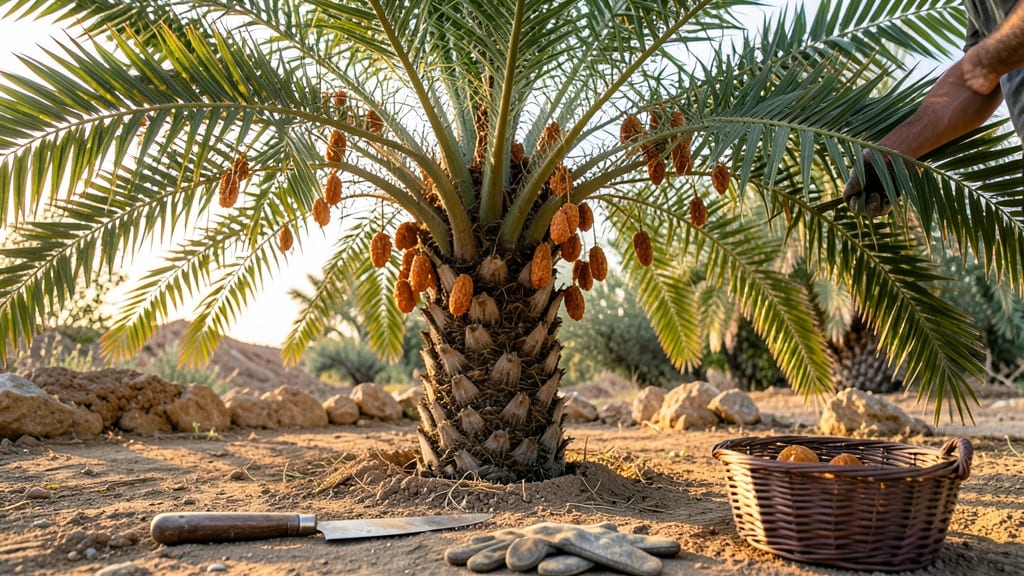
Dates come from the date palm tree (Phoenix dactylifera), a resilient desert palm originally from the Middle East and North Africa that thrives in extreme heat with minimal water and sandy soils. Its striking fronds and sweet fruit have made it a staple in arid landscapes for centuries.
This iconic palm isn't just drought-tolerant—it's a survivalist. 🌵 The Phoenix dactylifera (its scientific name) can grow up to 100 feet tall in ideal conditions, though most cultivated varieties stay between 50-75 feet.
What's fascinating is how its deep root system taps into underground water sources while its waxy leaves minimize moisture loss. These adaptations explain why date palms have been cultivated for over 5,000 years—they're the perfect fruit tree for regions where other crops would wither.
The fruit itself develops from small, creamy-white flowers that appear in clusters along the tree's trunk. Female flowers produce dates, while male flowers (on separate trees) provide pollen. This separation is why commercial growers often plant both male and female palms in close proximity.
The fruit's journey from blossom to harvest takes about 4-6 months, during which the sugar content increases dramatically—giving dates their signature sweetness.
💡 In This Article
- Date Palm Tree Species and Growing Conditions
- How to Grow Date Palms in Home Gardens
Date palm tree species and growing conditions
The date palm (Phoenix dactylifera) belongs to the Arecaceae family, specifically the genus Phoenix—which includes around 12 other palm species, though none produce edible fruit like this one. What sets it apart is its remarkable genetic adaptation to extreme environments.
Its genome contains specialized genes for drought resistance, including those that regulate stomatal closure (the tiny pores on leaves that control water loss). These adaptations allow the tree to survive with as little as 10 inches of rainfall annually, a fraction of what most fruit trees require.
The ideal climate for date palms falls within USDA hardiness zones 9-11, where temperatures consistently stay above 40°F year-round. The tree thrives in sandy or loamy soils with excellent drainage—poor soil retention can lead to root rot.
Interestingly, date palms also exhibit a unique "water storage" mechanism: their thick trunks can hold up to 1,000 gallons of water during monsoon seasons, which they slowly release during dry periods. This internal reservoir is why date palms can survive months without external water sources.
One fascinating aspect is how the tree's height correlates with fruit quality. Taller palms (up to 100 feet) produce smaller, more concentrated dates, while shorter varieties (around 30-40 feet) yield larger, softer fruit.
The tree's reproductive cycle is equally precise: female flowers bloom first, followed by male flowers 2-3 weeks later to ensure cross-pollination. Without this timing, fruit development would fail—a critical factor in commercial orchards where hand-pollination is often required for optimal yields.
Date palms also demonstrate an intriguing relationship with their environment through a process called "halophyte tolerance." While they prefer fresh water, they can survive in slightly saline conditions (up to 2,000 ppm salinity), making them ideal for marginal lands where other crops would fail.
This trait explains why date palms have been cultivated along ancient trade routes like the Silk Road, where soil salinity was often high. The tree's ability to filter and store water efficiently makes it one of nature's most resilient agricultural crops.
What's often overlooked is how the tree's physical structure contributes to its survival. The iconic feather-like fronds (technically called "pinnae") have a waxy coating that reduces water evaporation by up to 40% compared to non-coated leaves.
Even the tree's roots play a dual role: shallow roots spread horizontally to absorb surface moisture, while a single deep "taproot" can extend 15-20 feet downward to access groundwater. This dual-system approach is why date palms can thrive in both coastal deserts and inland oases.
For those curious about cultivation, understanding these adaptations is key. Date palms don't just tolerate harsh conditions—they thrive in them, making them one of the most sustainable fruit crops on Earth.
Their ability to produce high-sugar fruit with minimal resources is a testament to millennia of natural selection in some of the planet's most challenging environments. 🌵